
Abstract
Otologic pathology is a well-known, though potentially underdiagnosed, complication of syphilis. While it is most commonly considered a manifestation of early latent or secondary syphilis, otologic symptoms can develop at any stage of the disease and may be associated with neurosyphilis. Given the increased prevalence of syphilis, clinicians must maintain a high index of suspicion for this less recognized manifestation. Failure to diagnose and properly treat otologic complications can result in permanent and profound hearing loss. This report presents a case of delayed diagnosis in late-onset otosyphilis.
1. Introduction
Syphilis is a sexually transmitted infection (STI) caused by Treponema pallidum. The infection is known to result in a wide array of acute and chronic pathologies, affecting multiple organ systems. If not diagnosed and treated promptly, syphilis can result in severe and often permanent vascular and neurological complications. In wealthy nations, the incidence of syphilis has increased sharply in recent years, leading to a corresponding rise in complications, such as ocular and congenital syphilis [1,2].
Although literature on otosyphilis is sparse, evidence points to an increased incidence, particularly among high-risk populations in large metropolitan areas and tertiary care centers [3]. Despite the increase in the incidence of syphilis and associated complications, otosyphilis is still likely underdiagnosed, largely because it can present in the absence of other more common manifestations of syphilis. Often, auditory symptoms may be dismissed, especially in cases where presbycusis is suspected or where social history includes confounding factors such as occupational exposure to loud noise.
Otosyphilis typically presents with sensorineural hearing loss, tinnitus, and vertigo [1]. While most cases are diagnosed during early or secondary syphilis, otosyphilis can present at any stage of the disease [3,4].
2. Case Presentation
A 49-year-old male visited a primary care clinic with concerns about chronic, progressive left-sided hearing loss and tinnitus. His medical history included polysubstance use disorder, hypertension, and chronic transaminase elevation, previously suspected to be secondary to metabolic-associated steatosis liver disease, with a negative viral hepatitis panel. The patient reported bilateral tinnitus and unilateral left-sided hearing loss, which had been worsening over more than a year. Hearing loss was not severe enough to require hearing aids. He noted previous employment in a noisy environment as a chef but had left that position over a year before and believed the hearing loss had progressed since then. One year prior, he was referred to Otolaryngology or sudden onset high-frequency sensorineural hearing loss and tinnitus; at that time, further work-up was deferred in favor of conservative management and observation due to his history of noise exposure.
In a review of his sexual history, the patient reported frequent sexual activity with both men and women, often without barrier contraception. He had never been tested or treated for sexually transmitted infections. When asked about past symptoms, he recalled a painless genital lesion that resolved spontaneously about 15 to 20 years prior.
Physical examination was largely unremarkable except for suspected left-sided hearing loss. Tympanic membranes were intact, with normal light reflex and no erythema bilaterally. Pupils were reactive, visual fields were intact, and there were no rashes or skin lesions.
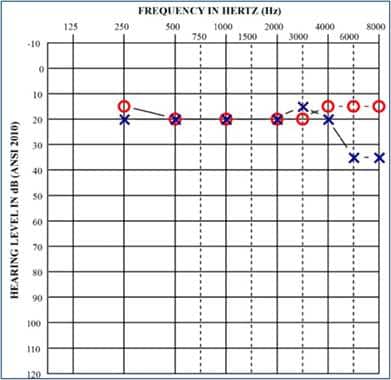
Laboratory evaluation showed positive total treponemal antibody which reflexed to positive rapid plasma reagin with a titer of 1:4, as well as aspartate aminotransferase and alanine aminotransferase elevation to 41 IU/L and 77 IU/L, respectively. The rest of a standard STI panel including HIV, gonorrhea and chlamydia was negative. The patient was referred to audiology to confirm suspected hearing loss and to Infectious Diseases and Otolaryngology for further evaluation of suspected otosyphilis and consideration for lumbar puncture. Audiology confirmed unilateral left-sided, high-frequency hearing loss (see Figure 1).
The patient subsequently underwent lumbar puncture. Cerebrospinal fluid (CSF) studies were positive for treponemal antibody but otherwise unremarkable, with a protein of 33 mg/dL, CSF white blood cell count of 0 cells/uL, red blood cell count of 1 cells/uL, and negative VDRL test. He was treated with a 2-week course of ceftriaxone for otosyphilis and reported significant improvement in tinnitus and some subjective improvement in left-sided hearing loss. Of note, there was also resolution of the patients transaminase elevation, indicating likely syphilitic hepatitis. Ophthalmologic evaluation revealed no concern for ocular syphilis. At time of publication, the patient had been referred for both repeat audiologic testing and magnetic resonance imaging of the temporal bone but had not followed up.
3. Discussion
Syphilis, caused by Treponema pallidum, can cause significant morbidity if not diagnosed and treated promptly, with possible complications including permanent and severe neurologic and vascular disease. In the United States, the rate of reported syphilis cases has increased substantially in recent years, with CDC data showing an increase of 57.2% between 2019 and 2023 [1]. Data on neurosyphilis, ocular syphilis, and otosyphilis are sparse, but available evidence suggests otosyphilis is relatively rare, with an estimated prevalence of 0.4% among syphilis cases [5]. Otosyphilis can develop at any stage, though it most often manifests during early or secondary syphilis [6–9]. This report details diagnostic delay and missed opportunity for early treatment in a case of isolated sensorineural hearing loss and tinnitus as presenting manifestations of late syphilis.
The presentation of otosyphilis is highly variable. The most common symptoms are sensorineural hearing loss (unilateral or bilateral), tinnitus, and vestibular symptoms, such as vertigo [6,10]. Hearing loss severity ranges from mild to severe, with no consistent predilection for high or low frequency identified in the literature [6]. As noted, otosyphilis, like neurosyphilis and ocular syphilis, can present at any stage, but most often occurs in early latent or secondary stages. As in this case, onset is usually acute but can also be subacute or chronic, and is often progressive if not treated [7,10]. Otosyphilis can present with neurosyphilis, but more often occurs without central nervous system involvement, as in this case. A retrospective review showed a 5.4% prevalence of neurosyphilis in confirmed otosyphilis cases [5]. Due to its clinical heterogeneity and potentially insidious onset, otosyphilis presents a significant diagnostic challenge. Isolated, mild hearing loss may be dismissed, especially in older persons or if there are confounding factors such as this patients history of occupational exposure to loud noise. Thus, delays in diagnosis are likely common and may result in more severe symptoms with a lower chance of improvement after treatment [6,10]. Because of this, it is important to maintain a high index of suspicion for syphilis in new neurosensory hearing loss, particularly because it is often treatable, especially if diagnosed early.
Because otosyphilis is relatively rare, its pathophysiology is not fully understood. Heterogeneity in presentation suggests multiple potential mechanisms. One hypothesis is spirochete invasion of the eighth cranial nerve, centrally or peripherally [3]. Another possible mechanism, accounting for some cases with tinnitus and vertigo, is early invasion of the perilymph space [3]. Rarely, pathological changes in the temporal bone and ossicles occur in long-standing and congenital syphilis, likely due to development of vasculopathy with subsequent necrosis of the periosteum [3,11,12]. While cross-sectional imaging of the head has limited diagnostic value for otosyphilis, as these findings are nonspecific and may occur in other inflammatory processes, it can be useful to rule out new intracranial pathology, such as demyelinating or space-occupying lesions [3].
Otosyphilis is typically treated with a 14-day course of intravenous (IV) penicillin. In this case, the patient received 14 days of IV ceftriaxone because continuous infusion was not feasible for social reasons. While penicillin is still preferred, ceftriaxone has emerged as a viable alternative, with retrospective analyses showing similar efficacy in both neurosyphilis and ocular syphilis [4,13,14]. While not strictly necessary according to the CDC 2023 guidelines, lumbar puncture (LP) is often performed to rule out central nervous system involvement [1,3,4,15].
In this case, LP was performed, and CSF studies were positive for fluorescent treponemal antibody absorption (FTA-ABS) but negative for VDRL with normal protein of 33 mg/dL and zero CSF white blood cells. Interpreting CSF studies is often challenging, and test characteristics as well as patient presentation must be considered in the diagnosis of neurosyphilis. Unfortunately, no one test is sufficient to diagnose neurosyphilis [2].
Broadly, laboratory evaluation for neurosyphilis considers treponemal and non-treponemal serologies, as well as CSF cell count, differential, and quantity of protein. Treponemal tests include CSF-FTA-ABS and CSF-Treponema pallidum particle agglutination assay (CSF-TPPA), and have very high sensitivity, making them useful in ruling out neurosyphilis [16]. Sensitivity of CSF-FTA-ABS approaches 100% [16,17]. However, it is important to note that due to the possible passive transfer of T. pallidum immunoglobulin G (IgG) across the blood–brain barrier, treponemal tests are not specific for neurosyphilis [18,19]. Indeed, in studies in which true negatives are defined as those without neurosyphilis, the specificity for CSF-TPA-ABS has been observed to be as low as 55% [18]. Based on limited available evidence, CSF-TPPA appears to have similar test characteristics to CSF-FTA-ABS [18]. CSF-VDRL is the only non-treponemal test recommended by the CDC to be used in CSF analysis [2,18], and has a specificity approaching 100%, but correspondingly lower sensitivity [16,18]. Finally, CSF pleocytosis of more than 5 cells per cubic millimeter and elevated CSF protein are often used to support the diagnosis of neurosyphilis [19]. While pleocytosis is sensitive, it is not specific, and elevated protein is neither sensitive nor specific [19].
Another important consideration in the diagnosis of neurosyphilis is clinical presentation. A microcosm of the infection more broadly, the presentation of neurosyphilis is extremely variable. However, in early syphilis, presentation often involves meningitis, commonly with cranial nerve abnormalities [19]. Late manifestations of neurosyphilis classically include general paresis and tabes dorsalis [19]. However, it is important to note that many neurosyphilis cases are asymptomatic. In HIV-negative populations, the rate of asymptomatic neurosyphilis ranges from 26.6% to 64% based on the available literature [19–22].
In this case, because the patient had only a positive CSF-TPA-ABS with negative CSF-VDRL and no other CSF abnormalities or clinical findings supportive of neurosyphilis, it is unlikely that there was CSF involvement. Especially in the setting of long-standing syphilis, it is more likely that the positive CSF-TPA-ABS represented passive transfer of T. pallidum IgG.
Recovery is variable, but improvement is relatively common among patients followed with repeat audiologic examinations, with one systematic review showing improvement in 57% of documented outcomes [6,9,10]. However, delayed treatment decreases the likelihood of improvement, with one multicenter case series showing a significantly lower chance of symptomatic improvement in those with symptoms lasting more than 1 year [6,10]. The role of adjunctive steroids in treatment is unclear; a retrospective review of 85 cases found some improvement with steroid treatment, but results were not statistically significant [6]. Thus, while they may be considered for severe or refractory cases, further research is needed to clarify their efficacy.
Finally, inherent to the prompt recognition and treatment of STIs such as syphilis are broader implications for public health. Though the underlying causes are complex, involving entrenched structural and institutional factors, it is well documented that marginalized groups often suffer from higher rates of STIs [15]. Among the most important reasons for this disparity are differences in healthcare access and screening [15]. Thus, prompt diagnosis and proper STI screening are critical points at which intervention by individual healthcare providers can have important public health impacts, ie, a reduction in STI prevalence [23]. In the case described, earlier identification and intervention could have considerably improved the patients chances for complete recovery and prevented further transmission of the infection.
These considerations highlight the need for increased clinical vigilance regarding otosyphilis. Greater awareness among healthcare providers, paired with proactive testing and prompt treatment, is critical. By recognizing otosyphilis as both a diagnostic challenge and an opportunity, clinicians can enhance patient outcomes and contribute to broader public health efforts in controlling syphilis transmission.
4. Conclusions
Otosyphilis is a rare and diagnostically challenging manifestation of syphilis, a disease already known for its diagnostic difficulties. Because of its rarity, further study is needed to clarify both its pathophysiology and the role of adjunctive therapies, such as steroids, in its treatment. Clinicians should maintain a high index of suspicion for otosyphilis. Given the variability in presentation and the increased risk of permanent debility if not recognized and treated early, as well as its broader implications for public health, otosyphilis should always be considered in patients presenting with new hearing loss, tinnitus, or vestibular symptoms.
Author Contributions
M.O.: conceptualization, investigation, writing (initial draft). M.A.: supervision, writing (editing, revision). All authors have read and agreed to the published version of the manuscript.
Funding
No additional outside funding was accepted for this project.
Institutional Review Board Statement
Our institution does not require IRB approval for individual case reports.
Informed Consent Statement
Written informed consent was obtained from the patient for publication of this case report and any accompanying images. Our institution does not require ethical approval for reporting individual cases.
Data Availability Statement
All data generated or analyzed during this study are included in this published article.
Conflicts of Interest
All authors declare that they have no conflicts of interest to disclose.
References
- CDC. Sexually Transmitted Disease Surveillance 2023. 2023. Available online: https://www.cdc.gov/sti-statistics/media/pdfs/2025/09/2023_STI_Surveillance_Report_FINAL_508.pdf (accessed on 10 June 2026).
- CDC. Morbidity and Mortality Weekly Report Sexually Transmitted Infections Treatment Guidelines, 2021 Centers for Disease Control and Prevention MMWR Editorial and Production Staff (Serials) MMWR Editorial Board. 2021. Available online: https://www.cdc.gov/std/treatment-guidelines/STI-Guidelines-2021.pdf (accessed on 10 June 2026).
- Ramchandani, M.S.; Litvack, J.R.; Marra, C.M. Otosyphilis: A review of the literature. Sex. Transm. Dis. 2020, 47, 296–300. [CrossRef] [PubMed]
- CDC. Sexually Transmitted Infections Surveillance, 2023. STI Statistics. 12 November 2024. Available online: https://www.cdc.gov/sti-statistics/annual/index.html (accessed on 10 June 2026).
- Jackson, D.A.; McDonald, R.; Quilter, L.A.S.; Weinstock, H.; Torrone, E.A. Reported neurologic, ocular, and otic manifestations among syphilis cases—16 states, 2019. Sex. Transm. Dis. 2022, 49, 726–732. [CrossRef] [PubMed]
- Pittman, C.A.; Liu, H.; Kowkuntla, S. Contemporary clinical management of otosyphilis for practicing otolaryngologists—A scoping review. Laryngoscope 2025, 135, 4490–4498. [CrossRef] [PubMed]
- Theeuwen, H.; Whipple, M.; Litvack, J.R. Otosyphilis: Resurgence of an old disease. Laryngoscope 2018, 129, 1680–1684. [CrossRef] [PubMed]
- Witt, L.S.; Fujita, A.W.; Ho, J.; Shin, Y.M.; Kobaidze, K.; Workowski, K. Otosyphilis. Open Forum Infect. Dis. 2022, 10, ofac685. [CrossRef] [PubMed]
- Sarsak, E.W.; Omer, W.E.; Al Bishawi, A.A.; Al Maslamani, M.; Abdulmajed, A.A.B. Otosyphilis: A rare case of reversible hearing loss in a young man with secondary syphilis. IDCases 2023, 31, e01666. [CrossRef] [PubMed]
- Yimtae, K.; Srirompotong, S.; Lertsukprasert, K. Otosyphilis: A review of 85 cases. Otolaryngol.–Head Neck Surg. 2007, 136, 67–71. [CrossRef] [PubMed]
- Ogungbemi, A.; Dudau, C.; Morley, S.; Beale, T. Computed tomography features of luetic osteitis (otosyphilis) of the temporal bone. J. Laryngol. Otol. 2014, 128, 185–188. [CrossRef] [PubMed]
- Kivekäs, I.; Vasama, J.-P.; Hakomäki, J. Bilateral temporal bone otosyphilis. Otol. Neurotol. 2014, 35, e90–e91. [CrossRef] [PubMed]
- Bettuzzi, T.; Jourdes, A.; Robineau, O.; Alcaraz, I.; Manda, V.; Molina, J.M.; Mehlen, M.; Cazanave, C.; Tattevin, P.; Mensi, S.; et al. Ceftriaxone compared with benzylpenicillin in the treatment of neurosyphilis in France: A retrospective multicentre study. Lancet Infect. Dis. 2021, 21, 1441–1447. [CrossRef] [PubMed]
- Gu, X.; Lu, H.; Yang, Y.; Zhu, L.; Shi, M.; Guan, Z.; Ni, L.; Peng, R.; Zhao, W.; Wu, J.; et al. Could ceftriaxone be a viable alternative to penicillin for the treatment of ocular syphilis? Antimicrob. Agents Chemother. 2024, 68, e00080-24. [CrossRef] [PubMed]
- Henriquez, P.S.; Heimesaat, M.M. Ethnic disparities in prevalence and screening rates of sexually transmitted infections. Eur. J. Microbiol. Immunol. 2025, 15, 164–171. [CrossRef] [PubMed]
- Park, I.U.; Tran, A.; Pereira, L.; Fakile, Y. Sensitivity and specificity of treponemal-specific tests for the diagnosis of syphilis. Clin. Infect. Dis. 2020, 71, S13–S20. [CrossRef] [PubMed] [PubMed Central]
- Gonzalez, H.; Koralnik, I.J.; Marra, C.M. Neurosyphilis. Semin. Neurol. 2019, 39, 448–455. [CrossRef] [PubMed]
- Davis, L.E.; Schmitt, J.W. Clinical significance of cerebrospinal fluid tests for neurosyphilis. Ann. Neurol. 1989, 25, 50–55. [CrossRef] [PubMed]
- Ghanem, K.G.; Ram, S.; Rice, P.A. The modern epidemic of syphilis. N. Engl. J. Med. 2020, 382, 845–854. [CrossRef] [PubMed]
- Castro, R.; Prieto, E.S.; da Luz Martins Pereira, F. Nontreponemal tests in the diagnosis of neurosyphilis: An evaluation of the Venereal Disease Research Laboratory (VDRL) and the rapid plasma reagin (RPR) tests. J. Clin. Lab. Anal. 2008, 22, 257–261. [CrossRef] [PubMed] [PubMed Central]
- Cai, S.N.; Long, J.; Chen, C.; Wan, G.; Lun, W.H. Incidence of asymptomatic neurosyphilis in serofast Chinese syphilis patients. Sci. Rep. 2017, 7, 15456. [CrossRef] [PubMed] [PubMed Central]
- Zhu, L.; Gu, X.; Peng, R.-R.; Wang, C.; Gao, Z.; Zhou, P.; Gao, Y.; Shi, M.; Guan, Z.; Seña, A.C. Comparison of the cerebrospinal fluid (CSF) toluidine red unheated serum test and the CSF rapid plasma reagin test with the CSF Venereal Disease Research Laboratory test for diagnosis of neurosyphilis among HIV-negative syphilis patients in China. J. Clin. Microbiol. 2014, 52, 736–740. [CrossRef] [PubMed] [PubMed Central]
- Cantor, A.; Dana, T.; Griffin, J.C. Screening for chlamydial and gonococcal infections. JAMA 2021, 326, 957–966. [CrossRef] [PubMed]